















Science · What Is an Enzyme Toothpaste?
What Is an Enzyme Toothpaste?
Enzyme toothpaste uses biological catalysts — not just abrasive grit — to help break down plaque biofilm, food residues and stain films.
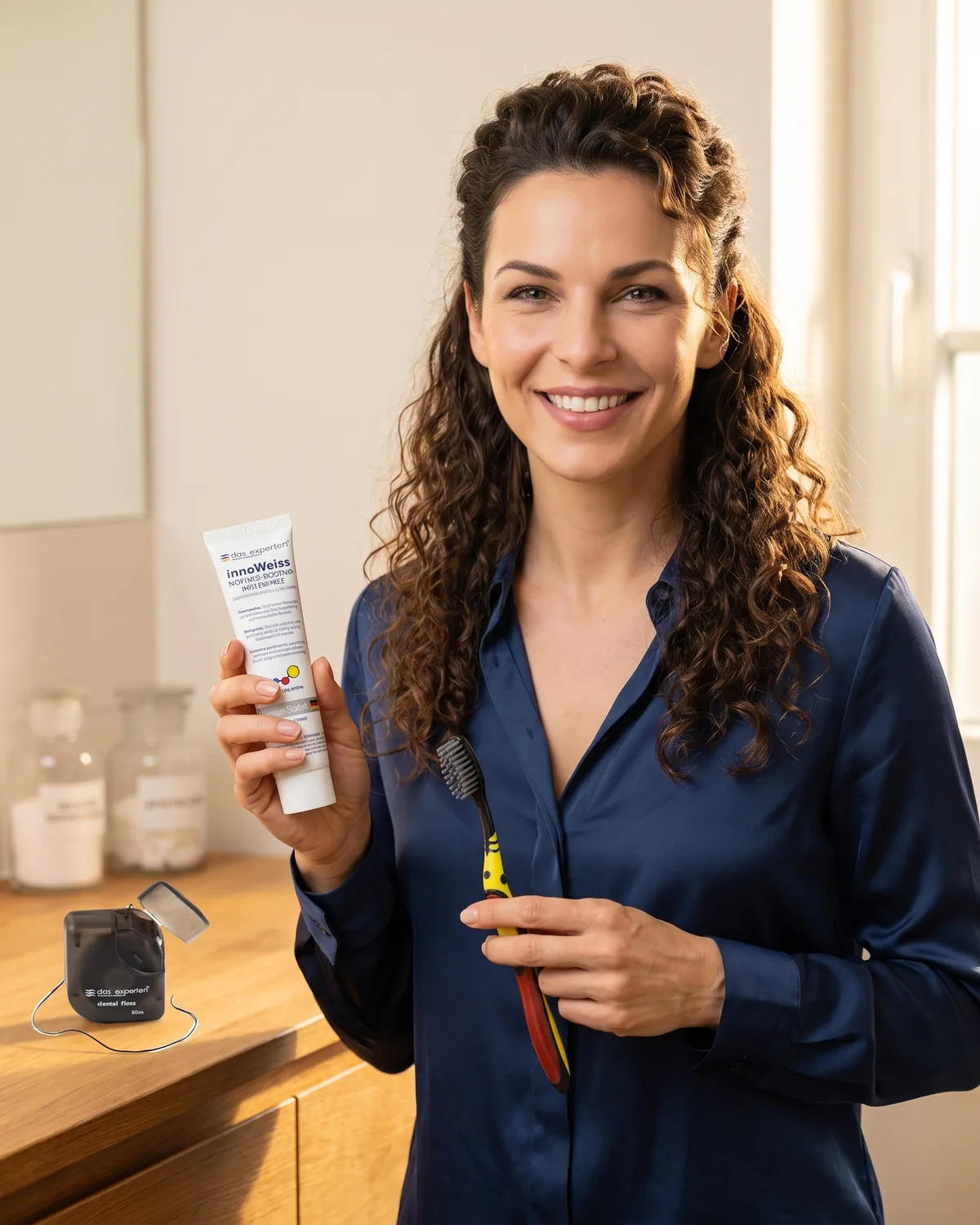
Conventional toothpaste cleans mostly through mechanical abrasion: gritty particles that physically scrape plaque and stain off the enamel surface, wearing a little of the tooth down with every brush. Enzyme toothpaste takes a different route. It uses proteolytic and glycolytic enzymes to digest the protein and polysaccharide structures that hold plaque biofilm and stain film onto the tooth, so the deposits loosen and lift away with a gentler brushing action rather than being ground off.
Mechanism
The five-enzyme system used in Das Experten INNOWEISS
| Enzyme | Role in the formula |
|---|---|
| Dextranase | Targets the sticky dextran matrix that holds plaque biofilm together |
| Invertase | Converts sucrose into smaller sugars that feed the enzyme cascade |
| Glucose oxidase | Supports mild oxygen-based cleaning chemistry |
| Papain | Breaks down protein-based surface stain film |
| Bromelain | Breaks down protein-based stain film alongside papain |
Benefits
- Targets plaque biofilm and stain film chemically, rather than relying only on abrasive grit.
- Can be formulated at a controlled, lower RDA (relative dentin abrasivity) than heavy-polish whitening pastes.
- A multi-enzyme cascade (dextranase, invertase, glucose oxidase, papain, bromelain) covers more of the biofilm and stain structure than a single-enzyme formula.
Limitations
- Enzyme toothpaste is not a substitute for professional dental cleaning or diagnosis.
- It is a daily-care mechanism, not a bleaching treatment — it does not lighten teeth beyond their natural shade the way peroxide bleaching can.
- Enzymes are proteins and can be sensitive to formulation conditions, which is why stability and pH balance matter in manufacturing.
Comparison
Many "enzyme" whitening toothpastes on the market rely on a single papaya-derived enzyme (papain) mainly for surface-stain polishing. A broader multi-enzyme system — such as the five-enzyme cascade in INNOWEISS (dextranase, invertase, glucose oxidase, papain, bromelain) — is designed to address both the plaque biofilm matrix and the protein stain film, rather than surface stain alone.
FAQ
What is enzyme toothpaste made of?
Enzyme toothpaste is built around biological enzymes such as dextranase, invertase, glucose oxidase, papain and bromelain, combined with the standard toothpaste base (humectants, mild surfactants, flavoring).
Is enzyme toothpaste better than regular toothpaste?
It is a different mechanism, not a strictly "better" one — enzyme toothpaste is designed to work chemically on plaque biofilm and stain film, which can make it a gentler option for people who want to reduce reliance on abrasive polishing.
Does enzyme toothpaste replace brushing technique?
No. Enzyme toothpaste still requires normal brushing; the enzymes assist the mechanical action rather than replacing it.
Which Das Experten product uses this technology?
INNOWEISS is the Das Experten multi-enzyme toothpaste, using dextranase, invertase, glucose oxidase, papain and bromelain.

Related
The Science hub · Dextranase in Toothpaste · Papain vs Bromelain · Which Enzymes Remove Plaque? · INNOWEISS product page